Notes · · 5 min read
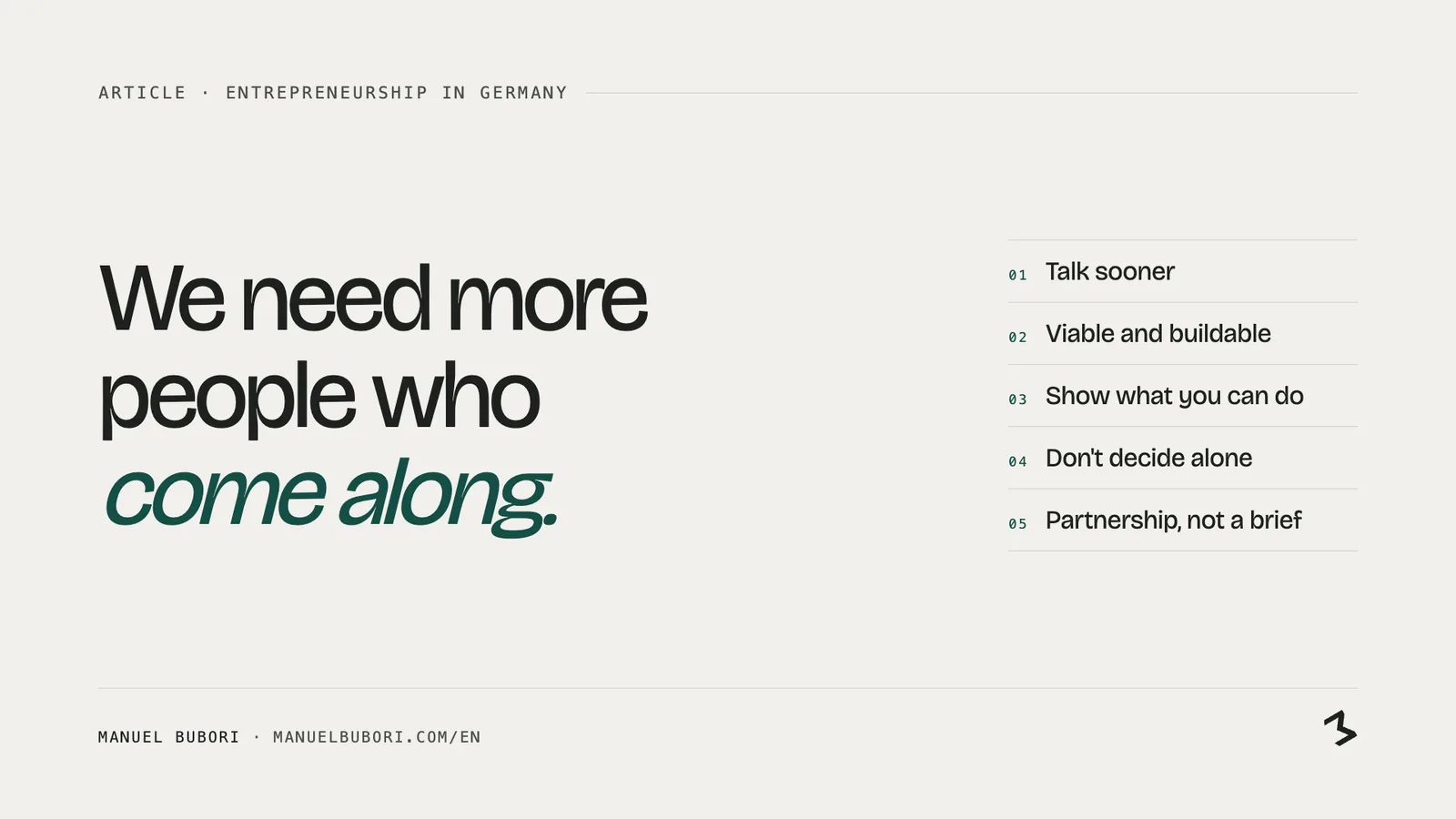
Entrepreneurship in Germany: We need more people who come along
There is a lot of talk about entrepreneurship: red tape, taxes, skilled workers. Far less about why ideas really fail, long before the first form is filled in. Five thoughts, each with what you can do differently tomorrow.
1. Talk sooner
We like to finish planning an idea before we talk about it. By then, all you get is a yes or a no, but no one who joins in. The best phase of an idea is while it is still wobbly.
The reason is easy to see: if you show up with half a thought, you look unprepared. So it gets calculated, secured and nicely formatted before anyone else gets to see it. But then no one can shape it anymore. Whoever joins later can only nod or shake their head.
How you notice you are talking too late: the first feedback is about details, not about the idea itself. Or there is no feedback at all, because nobody dares to question something that looks so finished.
What helps:
- Write the idea down in three sentences: who is it for, what problem does it solve, why now.
- Talk to two or three people about it before the first slide exists. Don't ask for approval, ask: what bothers you about it?
- Bring a sketch on purpose, not a concept. A napkin invites people to draw along, a bound concept doesn't.
2. Viable and buildable
A design has to pay off. And it has to be buildable. Many ideas fail because one of the two questions is asked too late.
One side has a beautiful concept that nobody wants to pay for. The other has a clean calculation for something that can't be produced, delivered or run that way. Both often only show once money and time are already in.
That's why I check both early. It isn't distrust of the idea, it's the respect it deserves. Four questions are enough to start:
- Who pays for it, and why exactly this price?
- What does it cost to make it once, and what to run it over time?
- Who builds it, with which tools, in what time?
- What is the smallest part you can use to test both before building everything?
If you have no answer to one of the questions, you don't have to drop the idea. But you know where to look next.
3. Show what you can do
Many small and mid-sized companies are excellent at what they do. Their public image rarely shows it. If you don't show what you can do, you lose to the louder ones.
That's not a reproach. When you deliver every day, there is little time to talk about yourself. And much of what a company does especially well is so normal to it that it no longer sees it as special.
How you notice it: new customers are surprised by everything that's possible. Applicants don't know what the company actually does. And the website, the trade fair stand and the vehicles tell three different stories.
What helps:
- Look at your own presence from the outside once, ideally with someone who doesn't know the company: do they understand within a minute what you can do?
- Write down the three things customers praise most often. These are usually exactly the ones that appear nowhere.
- Settle on one idea that applies everywhere: on the website, at the stand, in the quote. One idea, one look, everything from one mould.
4. Don't decide alone
Business owners usually discuss decisions with people who have a stake in the outcome. What's missing is someone who gains nothing from agreeing with them.
That's human. Employees want to keep their jobs, suppliers the contract, the family the peace. Each of them means well. But honest disagreement becomes rare, and if you are rarely contradicted, at some point you take your own view for the only one.
A good counterpart for a decision listens, asks questions and then says what they consider viable. Even if the answer is uncomfortable. Three questions help for the conversation itself:
- What would have to happen for this decision to look wrong in a year?
- What would I do if the most comfortable option disappeared?
- Who would feel uncomfortable contradicting me here, and why?
5. Partnership, not a brief
New ideas need people who think along instead of waiting for a brief. And who may share in the success. Agree on who owns what at the start. At the start it's a conversation, at the end it's a dispute.
The commission is the usual form of working together: one person knows what they want, another delivers it. That works when it's clear what is needed. With new ideas, that is exactly what's still open. Then the form holds things back: whoever only works to a brief delivers the brief, nothing more.
Partnership doesn't mean sharing everything. It means discussing a few things openly beforehand:
- Who brings what: money, time, skills, contacts?
- Who decides what, and what happens if you disagree?
- How is it shared if it works, and how if one side wants out?
Putting that in writing before you start isn't distrust. It's what lets you focus entirely on the work later.
What I wish for
More courage to share things unfinished. And more people who don't just watch a good idea, but come along.
If you're working on an idea like that: write to me. A napkin is enough to start.
First published on LinkedIn, in a shorter version. Read the article ↗︎ My profile ↗︎